Travelogues
Photo Gallery
Upcoming Destinations
- Har Ki Dun
- Ladakh
Ask Me
About Me

A Mukherjee World View | ||
|
|
||
|
Animals Seen and Unseen
Excitement doubtless enhances exhaustion and we all crashed disgracefully early that night. So we were considerably refreshed when we were woken at 5.30 a.m. the next morning. After two wonderful safaris, was it greedy to hope for more tigers and leopards? Probably, but I felt no qualms about being greedy.
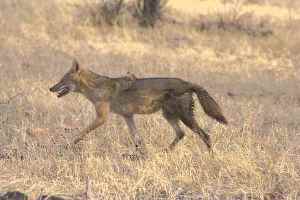
Some people claimed they could see at least one tiger, and they pointed out confusing and sometimes contradictory landmarks to everyone else in a medley of languages. Directions typically went as follows: See that dead tree over there? Not that one on the right, the one on the left behind the third rock from the jeep. Got it? See that fork in its branches, about two-thirds of the way up the trunk? Right. Now follow the direction of the upper branch till you see a rock. Got it? Ok, now just to the right of the rock, do you see a patch of green? Great. Ok, now look at about 21 degree to the north-east of that and eighteen feet along is a speck of gold which might be a tiger (or might be a dried leaf). I scanned all the separate landmarks through my telephoto lens and found nothing that could (even with a healthy dose of imagination) be construed as a tiger. At last, we gave up the quest for the imaginary tiger and resumed our track through the forest. Though our meanderings brought us no more big cats, we did see lots of other wildlife. The only predator we saw was jackal. They looked quite like domestic dogs, with characteristics of an Alsatian or German Shepherd, but smaller and less hairy. Sambar deer and spotted deer we saw times without number. Sambar deer, said our guide, have poor vision and don’t run too fast, which makes them the tiger’s favourite meal. They were quite shy of our jeep, but if we crept up on them silently and slowly I fancied I could see them “peering” at us in a short-sighted and somewhat wary fashion, wondering what fashion of animal we were.
A couple of times, we had a fleeting glimpse of a chinkara, which quickly vanished with a sort of jerky-graceful bounding gait. These are at the opposite end of the antelope spectrum, being small and light and fawn-colored. Of the deer and antelope species we saw, the chinkara are seriously endangered and the nilgai are threatened, but have been “exported” to Texas, where they are reported to be flourishing. On both days, we saw a lone Indian hare – presumably two different ones, as they were in quite different areas. These are really quintessential bunny rabbits. Unfortunately they move too quickly to be photographable. Other enthralling animals were of the rodent and reptilian variety. Mongooses (or mongeese?) could be spotted scurrying round in the dry leaves and towards the end of our safari Amit spotted a monitor lizard rushing across our path. This was a good catch, because these animals look so much like a leaf or a bark of a tree that they are virtually impossible for the untrained eye to spot (and perhaps for the trained eye as well, considering neither the driver nor the guide spotted it first). It is far from being a pretty creature, though one must admit that its particular brand of ugliness is quite compelling. After it had crossed the ground it rushed up a tree trunk and entertained us by pretending to be an inanimate object. Not all the action was on the ground. A variety of birds took wing and startled us with colors and shapes that seemed almost out of place in the forest. The golden oriole was as startlingly yellow as the bluejay was blue. The paradise flycatcher added not just a dash of color but also the excitement of a forked tail. A few honey buzzards swooped through the woods, and one perched on a branch posing for a portrait photograph. Kingfishers were not so common here, but we were lucky enough to see one. Peacocks were plentiful. Being large, heavy birds, they were most startling when they took to the air. Most often they gathered in small groups under shady trees and sometimes even sat in the dark, cool, hollow boles of trees. One peacock obligingly spread his wings and did a short dance for us (well, for his mate, actually). These apart, we saw lapwing, magpie robins, treepies, partridge (no pear tree though), vulture, and a painted stork. Since we hadn’t specifically gone looking for birds, these were really quite a bonus. Our drive and guide were on the lookout for an owl that had recently made its home in a large, leafy tree close to the track; but we never saw him.
At another watering hole we watched a crocodile sunning himself, mouth wide open. In the distance, a chinkara and a painted stork kept some female sambar company. It was interesting to see the animals go about their daily business, various vegetarian species comfortably mixing with each other, and keeping a healthy distance from the non-vegetarians. Langurs seemed to be everybody’s best friends, probably because from their vantage points they could give reliable information about predator movements. Of our favourite tiger family, we got word (other than from the monkeys) from various jeeps on the route. She had taken her cubs and herself and gone away up the hill, they said. One jeep had caught a fleeting glimpse of her on her way up. We diligently searched for her in the area she was last seen, and we did find pug marks, but of the lady herself we saw neither hair nor hide. So, at last, we made our way out. The high fort wall running along the top of the hill on our right looked down on us with infinite patience. How many people and animals had it seen come and go in its thousand years of existence? We hadn’t found a chance to explore its ramparts and the temple at the top. Perhaps we would meet again, that fort wall, those craggy cliffs, this dusty, dry landscape with all its magnificent and fascinating animals. I would like to think so – but only time will tell. |
|
|
|
Comments and information welcome. Write to
anamika dot mukherjee at amukherjeeworld dot net |

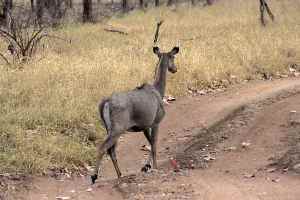 This time, though, we were not on our lucky Route 7. We were on route 2, which was reputed also to house a tigress and two cubs, but all we saw was some entrails and vague dragging marks in the sand. Apparently, the tigress had made a kill in the wee hours of the morning and dragged it right across the path and into the bushes to enjoy at leisure. We duly lined up behind some other jeeps and joined others peering intently into the scrub hoping to spot the family at breakfast.
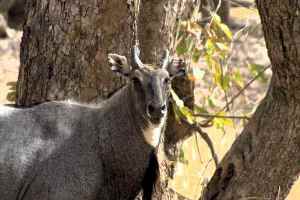 We also saw several nilgai, literally blue bull (gender in-specific, though the cows are not blue in color), which are a kind of very large antelope. The males were a dull blue-roan color (not a bright blue like a kingfisher) and large enough to look like small horses. They were not a very graceful sort of creature, but what can you expect of an animal whose scientific name in Latin and Greek means Ox, he-goat, camel and deer (Boselaphus Tragocamelus)?
 Though we set out that afternoon with un-dampened spirits, and were lucky enough to be assigned to Route 7 yet again, we saw nothing sensational. We went to our tigers’ lair, but they weren’t at home. Neither was the leopard, or if he was, he wasn’t being social. We did catch a chinkara standing still long enough for one shot at it, albeit rather a long shot; and, at a watering hole we had some fun watching the langurs and a peacock. The peacock bent its long neck gracefully to the water and looked just as though it was admiring itself in the natural mirror, before sipping daintily and raising its head between sips to survey its surroundings. The langurs were much more wary as they approached the water one-by-one. They would consider the matter carefully, sitting on their haunches and wondering whether it were worth the risk, before stooping to drink, tails curled up in the air or spread flat on the ground behind them.