Travelogues
Photo Gallery
Upcoming Destinations
- Har Ki Dun
- Ladakh
Ask Me
About Me

A Mukherjee World View | ||
|
|
||
|
Sights and More Sights
Of the Palace, Mint and Audience Hall there was little left. The Palace was now only a huge area of low platforms which would have been the basement. The book tells us the superstructure would have been made of wood, and was burnt down by the Muhammadan invaders who pillaged and destroyed the city in 1565. Now, it is difficult to even imagine how it might have been. The Audience Hall, too, was merely a high plinth. At one end was a high but not very large platform and the remains of what may have been steps to reach the top of it.
The King's Bath was one of the most perfectly preserved structures here, and quite beautiful. It had an interesting design of steps leading ever deeper in perfect symmetry. By contrast the bath for his guards, said to be the largest in Hampi, was plain and unadorned, though there was a tiny pavilion at one end. The Aqueduct, which supplied water to the King's Bath and also to many other tanks and fields in the area, is part of what is considered to be a very sophisticated irrigation system of the Vijayanagar empire. Here it was just about five feet high, and not very wide. It was made of large blocks of stone, with the odd carving here and there. We spent a long time in this area, because it was large and full of things to see. One of the more fascinating was the huge stone door. This was an exact, life-size replica in stone of the sort of wooden doors which normally guard the gateways to forts and temples. The two halves of the door lay on stone supports on the ground, with nothing to explain their position or, indeed, their very existence. We left the King's enclosure and returned to the road and very shortly we found ourselves at the Hazara Rama Temple. This grand and beautiful temple, being made almost entirely of stone, was extremely well preserved. And being the temple of the royal family, it was certainly ornate. There was an open, pillared courtyard around it and verandahs on three sides. Intricately carved black stone pillars held up the ceiling in the main chamber, while the walls outside were festooned with pictorial representations of the Ramayana. The Amman shrine, the shrine to the consort of the god, was equally elaborate. The entire compound had an open, soft, sweet feeling about it, difficult to capture or express. Regretfully turning our backs on it, we made for the Zenana, where, enclosed in extremely high (but, our guide book said knowledgeably, not very strong) walls, was the famous Lotus Mahal. This time it had even been accurately identified. We found it a bit disappointing, it being, like the Queen's Bath, a somewhat non-descript and plain two-storey building. Doubtless it did have the recessed arches which both made it famous and accounted for its name, but it seemed uninspiring. It sat on a high plinth and here there were no steps we could find. The original steps, which led also to the upper floor, were firmly barred.
There were maybe a dozen chambers, with variously domed roofs, the central one bearing the remains of a tower of which now only the base survives. In at least one of the chambers I noticed a narrow arched doorway leading into the neighbouring chamber, making one wonder what possible use the elephants could have made of it. The Guards' Chambers, a simple but appealing two-storeyed building with pointed Gothic (rather than Islamic) arches, has also been speculatively named a concert hall, or alternatively a guest house for the attendants of visiting elephants. Just around the corner of the Zenana wall, there is a ruined temple of Ranga, remarkable mainly for the stone sculpture of Hanuman measuring some nine feet from the pedestal to the top. Unfortunately, modern pillars constructed to support the ceiling stand right in front of the image, effectively preventing photography. |
|
|
|
Comments and information welcome. Write to
anamika dot mukherjee at amukherjeeworld dot net |

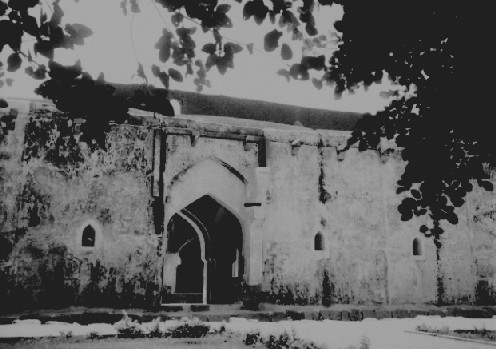 The Underground Chamber called for a
bit of hunting around - which is hardly surprising considering its
nature. It lay just behind the audience hall (if you face it with
your back to the road) and to the right of the Throne Platform
(facing that too, with your back to the road), somewhere close to the
ruins of the Palace. It was quite an intriguing little chamber and
our book speculated that it was a private chapel for the royal
family. There was a path down to it and around it, but we didn't
venture in.
The Underground Chamber called for a
bit of hunting around - which is hardly surprising considering its
nature. It lay just behind the audience hall (if you face it with
your back to the road) and to the right of the Throne Platform
(facing that too, with your back to the road), somewhere close to the
ruins of the Palace. It was quite an intriguing little chamber and
our book speculated that it was a private chapel for the royal
family. There was a path down to it and around it, but we didn't
venture in.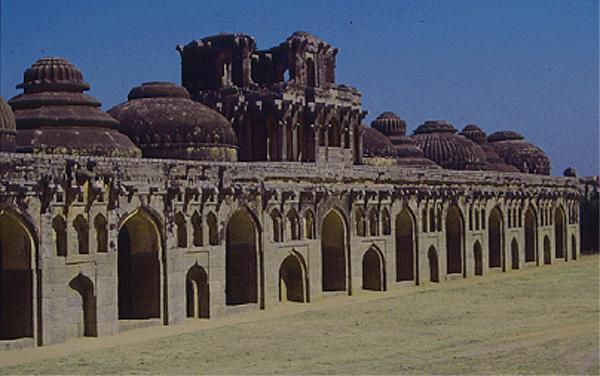 The
other buildings in the Zenana included two watch towers; whether they were meant
for security personnel to keep watch, or for the ladies of the harem to watch
the events outside remains a moot point. Through a doorway lay two interesting
buildings: the Elephant stables, and the Guards' Quarters. There seemed to be
some doubt as to how appropriate either of these appellations is. The Elephant
Stables seemed too nice to have been intended as accommodation for animals.
One guide book pointed to the absence of iron rings to tether the animals, though
another book said there used to be rings in the ceiling (but why tether them
to the ceiling?).
The
other buildings in the Zenana included two watch towers; whether they were meant
for security personnel to keep watch, or for the ladies of the harem to watch
the events outside remains a moot point. Through a doorway lay two interesting
buildings: the Elephant stables, and the Guards' Quarters. There seemed to be
some doubt as to how appropriate either of these appellations is. The Elephant
Stables seemed too nice to have been intended as accommodation for animals.
One guide book pointed to the absence of iron rings to tether the animals, though
another book said there used to be rings in the ceiling (but why tether them
to the ceiling?).