Travelogues
Photo Gallery
Upcoming Destinations
- Har Ki Dun
- Ladakh
Ask Me
About Me

A Mukherjee World View | ||
|
|
||
|
Lost... and Found
The ruins in Hampi are scattered over a large area, but the three main clusters are the buildings in the Citadel, closer to Kamalapur than to the modern village of Hampi; the ruins around the Virupaksha temple and Hampi Bazar at modern Hampi; and the Vithala temple complex with some of the nearby sites. These last two are connected by a footpath along which you will stumble, every so often, upon other important ruins. But the 3 km (or so we were told) footpath from the Zenana to Hampi has virtually no ruins along the way. It was this path that we now ventured upon, avoiding the main - motorable - road a slight detour away, which appeared in the map to be substantially longer for pedestrians. It was now four in the afternoon and we were desperate for the shortest route to civilization and food. We had counted on getting some kind of snacks from vendors at the ruins, but all we could find was the occasional cold-drink and bottled water vendor.
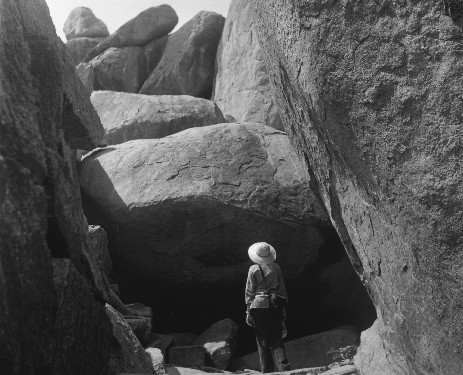
Some women of the village were on the path behind us. Hampi, we asked them. They indicated that we could either go what seemed to be the long way round the valley, or else go back and take a different path, which would be better. They led us to this path, just a short distance back (though we had completely failed to notice it) and we were on our own again. Now the path led over some ruins and then through a stunningly beautiful and desolate rocky patch where huge boulders perched in a delicately balanced jumble and threatened to flatten the immensely smaller stones which held them just inches off the ground. Eventually, encountering a herd of goat around a sharp curve of the hill, we found ourselves at a channel of the Tungabhadra, with two stone slabs serving as a bridge across. We crossed, and our troubles began anew. Go straight, our guides had directed us, and straight we had gone. Now the path went off to the left and right, upstream and downstream along the channel. Which way? As we wondered, we caught sight of a narrow path obscured by bushes. It was going straight, so, tentatively, we followed it. It became narrow and led in short order to a water body and there seemed to stop. We returned to our four-way intersection and introspected afresh. Then we set off upstream, for no good reason. After a while, for no good reason, we decided that was wrong, back-tracked and went downstream for a bit, also for no good reason. We had just decided that that was wrong too, as it seemed to lead right away altogether from the valley before us and were wondering whether it would be prudent to head back the way we had come and when we would get food, if we did - when our luck turned. Along came a coconut-gatherer with a cycle-ful of the fruits of his labour, which, being perhaps too heavy and bulky to ride with, he was pushing along at a pretty clip. He spoke good Hindi and told us we could follow him to Hampi. The path upstream would lead there, he said, as would the narrow path "straight" which we had first tried. But that would go through the jungle, he said, so we should go upstream. We obediently trotted behind him (somewhat breathlessly, on my part) as he effortlessly pushed his load over the ruts and slopes. And sure enough, the path turned, crossed the valley, and, still alongside the channel, run up to meet the main road, a brief ten minutes' walk from the nearest restaurant, which, having bid fond farewell to our trusty guide at the first coconut vendor, we made haste to locate. We had estimated an hour's walk from the Zenana to Hampi, and so it had been, despite our sundry ramblings. But it was now five o'clock and we couldn't even look at - forget admire and linger over - the alluring ruins right along the main road without first getting some food into ourselves. By the time this had been attended to, the sun was going down and the camera was reluctant to function. We, too, were still tired from our hot trek and the sun and hunger had combined to give me a throbbing headache. We had wanted to make it to the Vithala temple today, but when we asked an auto, he named a three-digit figure which caused us to jump out of our skins with horror. It was just 2 km away, so when we recovered sufficiently from the shock, we laughed and walked off. But the next auto driver we asked explained something we hadn't known before. The Vithala temple is indeed only a couple of km away, but there is no motorable path in that direction. (We discovered the reason the next day, when we traversed the path.) To go by road from where we were meant following the main road all the way to Kamalapur and then around a large looping path totalling 12 km. We decided the Vithala Temple could wait for the next day. We walked around lethargically for a bit and finally hopped in an auto back to our hotel. Amit was all set to walk, but with my throbbing headache, the prospect of a 4 km walk at 6.30 in the evening was more than I could face. We ate an early and barely sufficient dinner of a quality so indifferent as to border on the downright bad and were asleep by nine thirty! |
|
|
|
Comments and information welcome. Write to
anamika dot mukherjee at amukherjeeworld dot net |

 So we set off with hope in our
hearts and hunger in our tummies, across the sands and through the
huge boulders. At first it was easy. Then we came to a fork in the
path. Which way to go? We could see the rooftops of the houses which
we were headed towards. They seemed nearby. But we first had to cross
a valley. If the path went through it, it would be steeply uphill the
other side. If it went around the valley to one side, it would have
to skirt around a low but steep hill. If it circled round the valley
to the other side, it wold certainly be an extremely long route.
So we set off with hope in our
hearts and hunger in our tummies, across the sands and through the
huge boulders. At first it was easy. Then we came to a fork in the
path. Which way to go? We could see the rooftops of the houses which
we were headed towards. They seemed nearby. But we first had to cross
a valley. If the path went through it, it would be steeply uphill the
other side. If it went around the valley to one side, it would have
to skirt around a low but steep hill. If it circled round the valley
to the other side, it wold certainly be an extremely long route.