Travelogues
Photo Gallery
Upcoming Destinations
- Har Ki Dun
- Ladakh
Ask Me
About Me

A Mukherjee World View | ||
|
|
||
|
Sightseeing on Minicoy
Afterwards, we got a tour of the tuna canning factory as well. This was especially arranged for us; Amit had expressed an interest to the manager in the morning when we reached, and the manager remembered and set it up for us. It was an interesting visit. The type of tuna processed here weighs from 20 to 100 kg, but after discarding head, internals, and red meat, they get only about 25% of its weight in white meat. This is steamed in huge steamers, cooled overnight, cut into inch-cubes manually (by women - does that make it womanually?) weighed, placed in cans with 3 grams of salt, vacuumed, sealed, sterilised for an hour, and labeled. The factory had an installed capacity of 1500 cans a day, each can containing 185 grams of tuna. Having nibbled on bits of unsalted tuna, we thanked the people in charge and returned to the rest of the group. The girls slept while a particularly lively song-and-dance routine was on. Within a few minutes, tea was served and it was time to return to the ship. We spent part of the evening on the rear deck-cum-helipad, dodging diesel fumes and trying to ensure the girls remained onboard the ship. The rest of the evening passed in tidying up, getting all four of us fed and watered in three shifts as usual, and getting the girls to bed. I spent a few minutes on the swimming pool deck, and then it was time for bed. The next morning, I was up at 7 by force of habit. After bathing, dressing and packing, we went up on the deck to watch our arrival. At 9.30, there was still no sign of land on the horizon, but by 10.30 we had reached. It was close to 12 by the time the crowds had subsided enough so that we could easily leave. One of the ship's crew members made arrangements for an auto to be waiting for us when we reached the gate. Soon we were back in Kochi, at a hotel close to the train station, waiting to catch our train back to Bangalore. It had been a good trip; the ship was comfortable enough and the islands in the sun were really lovely. But it goes without saying that traveling with two small kids is not easy. It's also a pity that it's difficult to experience Lakshadweep in isolation. The only tourism is government sponsored, and that translates to package tours of the extremely mundane variety. Meals were all buffet with a small number of items and very mediocre quality; what's worse, you got about a 45 minute-window to grab your grub or go hungry. Embarkation and disembarkation was mostly a mela. It is never an easy thing to hop into a swaying boat in the open sea, but vast numbers of people jostling, laughing and panicking at either end does not make it any easier. And, saddest of all, you never could find yourself a quiet spot of beach, far away from everything else, you never could find a moment to make your own, a place, a meal, even a photograph, because there were always approximately 150 other people hanging around in the same space. But these were minor irritations. The islands were beautiful and the people in charge were as considerate and polite as anyone could be. And scuba diving was an eye-opening experience in every way. Yes, this is a place that maybe, maybe, hopefully, we will be finding our way back to sometime in the future. |
|
|
|
Comments and information welcome. Write to
anamika dot mukherjee at amukherjeeworld dot net |

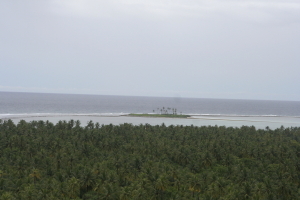 For a change, we went along on the village sightseeing tour. We were driven a short distance, then led along in a group through the village. It was quite well developed, as villages go. Many of the houses were nicely designed and constructed, there was a fair-sized school with a proper building, and the mosque was in mint condition. It seemed quietly prosperous, not rich, but not poverty-stricken either.