Travelogues
Photo Gallery
Upcoming Destinations
- Har Ki Dun
- Ladakh
Ask Me
About Me

A Mukherjee World View | ||
|
|
||
|
Day 2
The next day, we were off to an early start, shortly after seven. We took an auto straight to Vithala Temple. The road first led away from Hospet, then we took a fork left. After a while, we reached a barrier where we were stopped and were asked for a fee for using the Vithala Temple road. Our auto driver replied brusquely that the road was bad, why should he pay. This stumped the barrier man, who was little more than a teenager, and before he could think up a suitable reply, we were through.
We had planned an early start so that we would have enough time to take in the sights along the footpath leading to Hampi. The temple opened its gates at eight; it was the only monument, apart from the Zenana, to charge an entry fee and guard access to the premises through a gate. We were the first ones in. The Vithala Temple complex was huge and lovely. Our guide book described the various buildings in detail, but once there, it was so captivating even unidentified, that it just wasn't worth the effort of figuring out which was which. The Stone Chariot was there, in its small and perfect proportions. There were two large halls - one the main shrine, the other the Kalyana Mantapa - and one smaller one. There were also other small structures scattered around, all against the dramatic backdrop of huge boulders gathered into tiny hills which threatened to come crashing down and obliterate them at any moment.
It is said that the Vithoba idol for whom this temple was constructed, having visited, found it to be too grand and preferring his own humble abode at Sholapur (Mumbai) returned there forthwith. We spent a long time in the complex, much of it just absorbing the ambience without moving around too much. When we left, we were already an hour behind the schedule we had planned for ourselves and had no regrets. Outside the Vithala temple were many ruins. Since we had come by road from the Talarigatu side, we had come up along the path (hardly better than a footpath) that led alongside a long colonnade. This was one of the bazar streets of old, down which the chariot would roll at festival time. It was a long, broad avenue, culminating right at the entrance to the temple. Around the corner of the temple wall, beyond the main entrance was an unfinished gateway - too unfinished to be interesting - and the King's Balance. This was a high beam with three rings embedded in it for the scales to hang. It is said that on special occasions the King would weigh himself against gold or precious stones and would then distribute these amongst the Brahmins: a practice which, doubtless, met with immense approval among the Brahmin community. |
|
|
|
Comments and information welcome. Write to
anamika dot mukherjee at amukherjeeworld dot net |

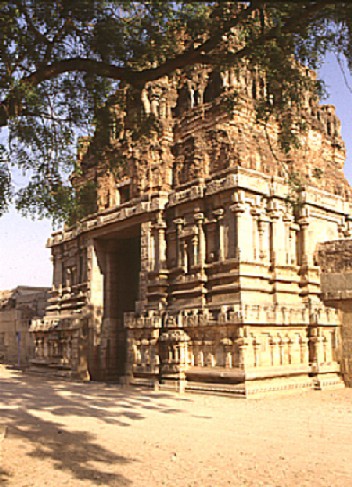 Another fork to the left and the road deteriorated seriously,
becoming an untarred and extremely unlevel surface. At one point we
had to get out and walk across a patch of large, jagged stones - of
the kind used to lay the road, but which are usually levelled with
pebbles and covered with tar - to avoid wrecking the auto.
Another fork to the left and the road deteriorated seriously,
becoming an untarred and extremely unlevel surface. At one point we
had to get out and walk across a patch of large, jagged stones - of
the kind used to lay the road, but which are usually levelled with
pebbles and covered with tar - to avoid wrecking the auto.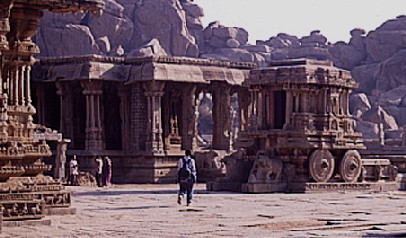 The buildings here are almost all
highly worked and ornamented. Though some renovation and restoration
work was in progress, and workmen, their materials and scaffolding
had made an appearance on the scene, it detracted nothing from the
tranquility of the stone buildings and the quiet grace with which
they regarded the megaliths around, certain in their knowledge of
five hundred years that none of the boulders would come crashing down
to disturb their peace.
The buildings here are almost all
highly worked and ornamented. Though some renovation and restoration
work was in progress, and workmen, their materials and scaffolding
had made an appearance on the scene, it detracted nothing from the
tranquility of the stone buildings and the quiet grace with which
they regarded the megaliths around, certain in their knowledge of
five hundred years that none of the boulders would come crashing down
to disturb their peace.