Travelogues
Photo Gallery
Upcoming Destinations
- Har Ki Dun
- Ladakh
Ask Me
About Me

A Mukherjee World View | ||
|
|
||
|
A Walk with a View
A short walk brought us to a magnificently sloping sheet of rock, at the top of which was a rather picturesque Jain temple. In fact, our guide book said there was no reliable evidence that it was ever a Jain temple, but as such it continues to be known. We climbed the steep steps, entered and sat in the deep shade at the top, under the canopy. From here we had a sweeping view of the area, and we could spot the cave - just across the path - where, it is said, Sugriva kept Sita's jewels when she was carried away by Ravan. Further away, a series of tall pillars led towards the river, echoed by another such series on the opposite bank. These once supported a bridge used to cross the river, though our guide book seemed skeptical about their merit as a feat of engineering. In view of our early start, we had skipped breakfast. It was now eleven, and we had done over three hours of walking already. With yesterday's experience still fresh in our minds, we decided to linger less and make reaching civilization a priority. Our path now took us along the river for a bit and the map indicated that Achyutaraya's Temple, Soolai bazar and the Varaha Temple would be on our way. However, planning to return after lunch (always a bad idea) we didn't want to stop to examine in detail the buildings we passed.
From this point on, the path became suddenly quite populated and we conjectured that the town was not too far off. As we followed it, the path ran up to a steep wall of rock and seemed to come to a sudden end. Only on walking to the very end could you find the sharp turn it took to wind its way right through the hill, finding spacious gaps between the gigantic black rocks. It was but a short stretch, yet enough to convince one of one point: an auto could never make it through here.
We decided from here to go on to the Matunga Parvatam, from the top of which there is said to be a wonderful view. Accordingly we set off and unexpectedly soon, without warning, arrived at the Hampi Bazar. This was a tremendously long, straight street with a pillared verandah running along both sides and terminating, at one end in the Virupaksha temple, and at the other in the monolithic Nandi sitting complacently under its tailor-made shelter. We went to this end first, then hunted for the steps leading up Matunga Parvatam, the low but steep hill in the background. Actually, the steps were not hard to find; rather it was the multiplicity of steps which made things rather confusing. We avoided the lot next to the Nandi, thinking they led only to the small pavilion perched atop them, and made for the more distant steps. |
|
|
|
Comments and information welcome. Write to
anamika dot mukherjee at amukherjeeworld dot net |

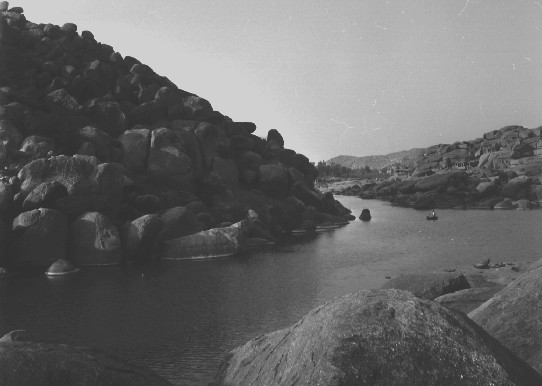 Our path led up to the back of the Kodananda
Rama Temple, a practicing temple. Here there was a cold drinks vendor
and we stopped for a while. The setting was unbelievable scenic,
close to the river where the tumbling hillside tried to stop at the
water's edge and for the most part succeeded, but for the odd boulder
which had managed to escape to the middle of the stream.
Our path led up to the back of the Kodananda
Rama Temple, a practicing temple. Here there was a cold drinks vendor
and we stopped for a while. The setting was unbelievable scenic,
close to the river where the tumbling hillside tried to stop at the
water's edge and for the most part succeeded, but for the odd boulder
which had managed to escape to the middle of the stream.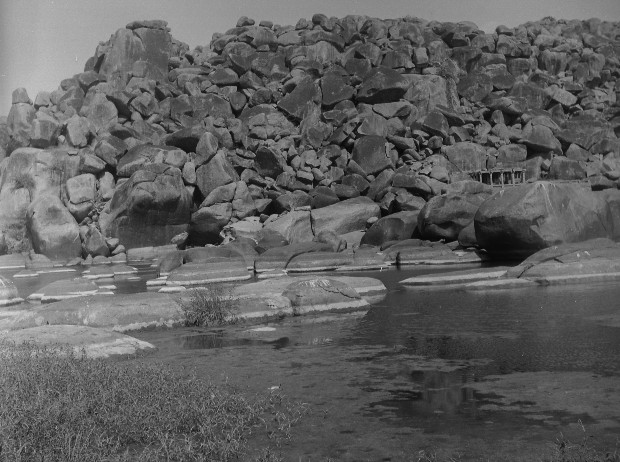 As we came out of the rocky passage,
suddenly we could see some food and drink stalls, and just beyond
them, a car! We were back on terra firma. We stopped at the first
stall and asked for food, rather startling the establishment who were
perhaps not used to serving up lunch at eleven thirty. However, one
fellow disappeared into the kitchen to start the fires and for the
next 20 minutes we were cruelly tortured by the tantalizing aroma of
food just out of reach.
As we came out of the rocky passage,
suddenly we could see some food and drink stalls, and just beyond
them, a car! We were back on terra firma. We stopped at the first
stall and asked for food, rather startling the establishment who were
perhaps not used to serving up lunch at eleven thirty. However, one
fellow disappeared into the kitchen to start the fires and for the
next 20 minutes we were cruelly tortured by the tantalizing aroma of
food just out of reach.